SB Tweet Digest #2 (march 2010)
april 02, 2010.

Since our previous
digest the SoundBlog
twitter birdie  yelped another 49 times. Here are some of this month's highlights, with comments and digressions, of course:
[9863885333]
Already quite
a while ago I managed to make a large group of Dutch natives "clog dance"
in the streets of the village of Dokkum to the sound and image of Dr. Bibber's
choco-sado hiprap, by simply aligning two different uTube clips
on a web-page and instructing the viewers to play them simultaneously. The
'collaborative music/spoken word project' In
B-flat 2.0, conceived by Darren
Solomon, takes this idea - which is as obvious as it is potent - a step
further. Darren put out an open call to musicians worldwide to make a uTube
clip in which each one sings or plays an instrument in B-flat
major. He assembles twenty of those in one web-page, where, again, the instruction is to play
(all, or a certain number) 'simultaneously' (which means: start them one after
the other, in some order).
[ In B-flat was partly inspired by Terry Riley's
In C.
Which reminds me of an article I read recently that did not
make it into a tweet. Not because it dated back to last christmas, of course,
but ... well ... though sort of informative, it somehow did not win me over enough. But if you're interested,
do hop over and give it a read. (David Ocker - Could
Terry Riley's In C be accepted as classical music?) ]
The sort of mix/mash that you can create and experiment with using
embedded uTube video clips, obviously works great also with a series of
soundfiles embedded in a web page.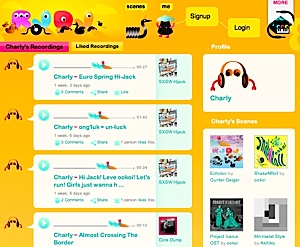 Thus
each of the many, many pages on the RjDj-website containing recordings that
were uploaded by the users of this reactive
music application becomes a ready-made instrument. Try it yourself:
just hop over to
RjDj-user Charly's profile page, and play around with the sounds ...
(use the first button, the triangular one, to start/pause the play-back
of a file). For the lazy and/or less DIY
ones among you, there's this SB-edition's
podcast: a short mash-mix made in one at once good-take, using
Charly's profile page in the way described above.
Thus
each of the many, many pages on the RjDj-website containing recordings that
were uploaded by the users of this reactive
music application becomes a ready-made instrument. Try it yourself:
just hop over to
RjDj-user Charly's profile page, and play around with the sounds ...
(use the first button, the triangular one, to start/pause the play-back
of a file). For the lazy and/or less DIY
ones among you, there's this SB-edition's
podcast: a short mash-mix made in one at once good-take, using
Charly's profile page in the way described above.
Quite an interesting manner, actually, to roam and discover RjDj's sonic universe. Also if you
do not (yet) have an i- or other smart-Thing that allows you to try out the app itself...
You can use the existing user- and application-pages, containing a wealth of user-upped recordings. Alternatively, you
may create an RjDj user-profile yourself, and then shop for recordings on the site to add to
your list of 'Liked Recordings'. These you then can play/mash/mix with in the corresponding section of your profile page.
Btw, all of this said:
it would be nice if it were possible also to remove files from a 'Liked' list. And, to enhance
the use of RjDj pages to mash/mix recordings, it would come in handy to have a volume-control
per recording; maybe also throw in the possibility to loop-playback a file? ... ;-) ...
[10329310115,
10693040217]
There was a lot of interesting RjDj news this month. So much, that not all
of it made it into the tweets.  The
SB-birdie did mention though that one
now can have paged scenes, which really is a great addition to
the application's possibilities. The Kids on DSP's new Core
Dump scene, for example, has four distinct 'modes'. Each mode has its
page, and you can switch modes by swiping pages (only sequentially, though,
forwards and backwards). A similar modularity is at work in the gorgeously
'old
school electronics' sounding SXSW Hijack scene, one of two
Kids on DSP scenes, released on the occasion of the 24th edition
of the SXSW®
Music and Media Conference, in Austin, Texas.
The
SB-birdie did mention though that one
now can have paged scenes, which really is a great addition to
the application's possibilities. The Kids on DSP's new Core
Dump scene, for example, has four distinct 'modes'. Each mode has its
page, and you can switch modes by swiping pages (only sequentially, though,
forwards and backwards). A similar modularity is at work in the gorgeously
'old
school electronics' sounding SXSW Hijack scene, one of two
Kids on DSP scenes, released on the occasion of the 24th edition
of the SXSW®
Music and Media Conference, in Austin, Texas.
[ The recordings used in User Charly's RjDj Mashymix, this
edition's podcast (click (right) to download
and/or listen  )
were made with ookoi's RjDj scenes, with Gunter Geiger's Echolon, and with Core Dump and SXSW
Hijack by Kids on DSP. SXSW Hijack was an 'event specific' scene and is not on
the official RjDj scenes list, but you'll find the secret link that will
allow you to grab this great scene, in the corresponding
soundblog tweet. ]
)
were made with ookoi's RjDj scenes, with Gunter Geiger's Echolon, and with Core Dump and SXSW
Hijack by Kids on DSP. SXSW Hijack was an 'event specific' scene and is not on
the official RjDj scenes list, but you'll find the secret link that will
allow you to grab this great scene, in the corresponding
soundblog tweet. ]
[ 10113477783 ] An awful lot of water has gone down the world's drains since I actively tried my hands at it myself (it was in days now far gone of ever longer growing listings of Fortran code compiled on monstrous PDP machines), but I always kept a keen interest in the promises and pitfalls of algorithmic composition. Besides of fractal geometry, non-commutative algebras, games and lots of other fascinating mathematics, the words remind me of the long hot summer nights that, almost thirty years ago now, I spent scrutinizing the about 1600 pages of the two heavy blue hardcover volumes of the Schillinger System of Musical Composition, writing and scribbling all kinds of notes, ideas and formulas onto a whole pack of bits and pieces of paper of different sizes. That soon after I then closed those and similar books, and put away that pack of papers, is another story. It did not end my fascination for the subject, but it probably does explain why I had not yet before heard of David Cope's work, which is the subject of "Triumph of the Cyborg Composer", a long, non-technical, article by Ryan Blitstein, that in turn was the subject of this March 7th tweet ...
[ 11137740989 ] The Arduino micro controller is a relatively recent and cheap open source programmable tool, that allows for quick and modifiable prototyping. It is used a lot by artists and designers, for a great many different reasons, in a lot of different contexts. I saw Jonah Bruckner-Cohen and Katherine Moriwaki use it to great effect in last year's Scrapyard Challenge workshop in the Palais de Tokyo, just to give one example. Because of its apparent versatility and ease of use, it has been high on my list of things to get and learn more about soon. This tweet links to a pdf version of Alicia Gibb's master's thesis on the Arduino and its use in new media art and design. For those interested in the technology and willing to cope with the pedantic and scholastic style of writing, there's a lot of valuable information to be found in Alicia's paper.
[ 10780443891
] I stumbled upon Rob Walker's colorful 'picture gallery with musings'
on the
idea of the cassette because one of the commenters
on Walker's article (Disquiet's
Marc Weidenbaum) linked in his comment to my recent
post on the Paris Tape Run ("from deep in the world of cassette-sound-art").
Almost all of the stuff exposed by Rob Walker in his gallery (some of which
you may already have come across elsewhere), falls into the category of
classy, colorful and trendy design much loved and sought after by many a
young and sometimes intelligent urban professional. This therefore is a
nice occasion to show you some 'cassette based goodies' that I acquired
some time ago, but that are of a rather more trashy sort.
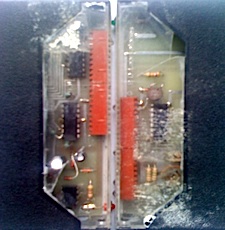
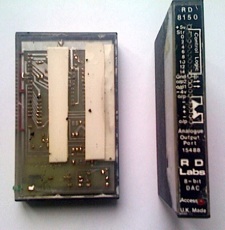
First, here's two cassette boxes, containing electronic circuitry. According
to the labels printed on the backs, one is an 8-bit DAC
(analogue output port 15488, RD 8150), the other an 8-bit ADC
(analogue input Module 15424, RD 8130), custom made - or so it seems - by
a UK-based outfit called RD
Labs:
 |
 |
Unfortunately I forgot where I got them. Maybe it was Cosmo or Flex that
dived them up somewhere? Or was it Rébus? It
for sure was Rébus who picked the following beauty from a dustbin
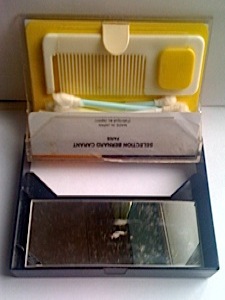
 somewhere near the university at Chévaleret: it is nothing less than a cas-set-de-voyage,
made in Japan (Fabriqué au Japon), and signed "Selection Bernard
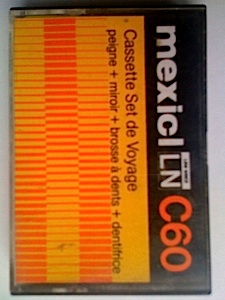
Carant, Paris". The cover is designed a bit like (or rather: the design
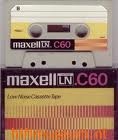
was ripped from) the Maxell LN C60, that you see in the image to
the left (courtesy the Dutch
online Hifimuseum). It says "mexicI LN C60", with above the 'LN' in
small capitals: "LOW NOICE". (It is unclear whether that 'c' in 'noice'
is there on purpose, caused by the 'made in Japan', or due to the Kindergarten
level of a French designer's English.) Bernard Garant's "Cassette Set de
Voyage" originally came with a little comb, a mirror, a toothbrush and toothpaste.
somewhere near the university at Chévaleret: it is nothing less than a cas-set-de-voyage,
made in Japan (Fabriqué au Japon), and signed "Selection Bernard
Carant, Paris". The cover is designed a bit like (or rather: the design
was ripped from) the Maxell LN C60, that you see in the image to
the left (courtesy the Dutch
online Hifimuseum). It says "mexicI LN C60", with above the 'LN' in
small capitals: "LOW NOICE". (It is unclear whether that 'c' in 'noice'
is there on purpose, caused by the 'made in Japan', or due to the Kindergarten
level of a French designer's English.) Bernard Garant's "Cassette Set de
Voyage" originally came with a little comb, a mirror, a toothbrush and toothpaste.
 |
 |
This cas-set-de-voyage just has to become a part of the travel gear of just about every cassetteur! ... I wonder, would maybe Bernard Carant not have some old stock left? ...
[ 11354065591
] There is a lot more analog tape lurking behind this tweet, dated
March 31st. 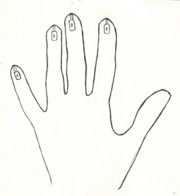 It
leads to a post on the Hack
a Day site describing an installation called Signal to Noise,
which, as a matter of fact, comes with its
own dedicated blog. If you go through that blog in reverse
direction, from bottom to top, starting at its
beginning, you get a nice step-by-step tour of "the making of" Signal
to Noise: a neatly executed variation on the idea of playing back stretches
of analog tape by means of a hand-held tape head. Here on the blog, a couple
of years ago, we met Colin Ponthot's Happy
Monster Tape. And somewhat later, in Berlin, Ben
Roberts, who is a specialist in hand-held magnetic media reading techniques,
that, as far as I can tell, found their earliest application in Nam June
Paik's Random
Access Music from 1963. For Signal to Noise the makers fitted
tape-heads into the fingertips of a glove, which is a nice and subtle twist.
When holding a smallish tape head between two of your fingertips you are
pinching, which is a closing movement. Sliding on a glove,
with tape heads in the tips, however, will incite you to open up
your hand. As a consequence, the approach and playing of the taped surface
will feel - and be - far more physical than in the case
you would approach it with a 'tape head pinched between fingers' reader.
The open hand makes the interaction very tactile. There is something
almost erotic about the gloved caressing of the taped surface (attached
to the wall as if it were a painting) by the people interacting with Signal
to Noise, as you can see in the short uTube below, shot at an exhibition
late 2009 in Brighton (UK). Hope some day I will be able to try - literally
:-) - my own hand at Signal to Noise ...
It
leads to a post on the Hack
a Day site describing an installation called Signal to Noise,
which, as a matter of fact, comes with its
own dedicated blog. If you go through that blog in reverse
direction, from bottom to top, starting at its
beginning, you get a nice step-by-step tour of "the making of" Signal
to Noise: a neatly executed variation on the idea of playing back stretches
of analog tape by means of a hand-held tape head. Here on the blog, a couple
of years ago, we met Colin Ponthot's Happy
Monster Tape. And somewhat later, in Berlin, Ben
Roberts, who is a specialist in hand-held magnetic media reading techniques,
that, as far as I can tell, found their earliest application in Nam June
Paik's Random
Access Music from 1963. For Signal to Noise the makers fitted
tape-heads into the fingertips of a glove, which is a nice and subtle twist.
When holding a smallish tape head between two of your fingertips you are
pinching, which is a closing movement. Sliding on a glove,
with tape heads in the tips, however, will incite you to open up
your hand. As a consequence, the approach and playing of the taped surface
will feel - and be - far more physical than in the case
you would approach it with a 'tape head pinched between fingers' reader.
The open hand makes the interaction very tactile. There is something
almost erotic about the gloved caressing of the taped surface (attached
to the wall as if it were a painting) by the people interacting with Signal
to Noise, as you can see in the short uTube below, shot at an exhibition
late 2009 in Brighton (UK). Hope some day I will be able to try - literally
:-) - my own hand at Signal to Noise ...
[  via kuz.b
]
via kuz.b
]
[ 11201594044
] [[ On Second Life and ookoi's machinima, WudyWudy ]] My SL started as early
as january 2007, with an
impromptu ookoi performance in some virtual cabaret, if I remember rightly.
It continued with a fine interpretation of 'Vicky's
Mosquitoes' by the AOM
all dressed up as ookoi,
in march of that same year. Personally I consider "OK!
Let's Dance!", the schizo-war/peace-dance that, dressed in nothing but his pale virtual skin, my avatar Hars Hefferman
performed ( * ) at the first (and only, I think) SL
edition of das kleine fieldrecordingsfestival, the high point in
my Second Life. It was on that occasion that I first met Evo Szuyuan,
already on her way then to become an esteemed and highly accomplished machinima film maker.
Evo is Dutch in Real Life. (And that is where we indeed
managed to meet some time later, in Dutchland.) After, I did continue to
every now and then participate in AOM
rehearsals and performances, and also enjoyed a couple of the SL
Dorkbots co-organized by Evo; but it proved too difficult to continue
to fit all of this into my already overbooked First Life. That is why, together
with SL, the AOM,
the fine people and avatars there more or less slipped away from my view.
My one and only recent visits to this virtual Wunderland were last
summer, when with Evo the ookoi did the rushes for WudyWudy, a short
but very exciting ookoi machinima clip, shot on the beaches of the SL
equivalent of the Dutch island of Ameland, where Captain
Haglet rules supreme... Evo still has to do the final editing of Woody,
so stay tuned for that some time later.
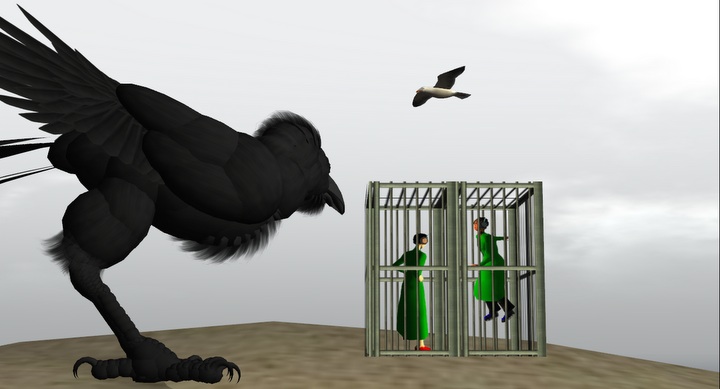
As a little teaser, here's a wonderful shot that she made of the ookoi caught on the Ameland beach
in a bird's cage, watched
by a ferocious animal. Click it for a larger version ....
|
All of the above merely to sketch the context of this particular tweet. It will help you understand why I felt so pleased when I found the nice write-up Michael Peters did in his recent post "My Avatar Is Not Blue". Here he describes his enchantment with an SL performance by the AOM last saturday March 27th, the orchestra still going strong and still including several good old avatar friends, like Bingo Onomatopoeia and Gumnosophistai Nurmi, just to name two of them.
I now know what it was that I felt when I read Michael's concert review.
It was something akin to nostalgia.
...
Next SB Tweet Digest in may.
! Follow @soundblog
_(
)_ iokoo@ wolloF
!
Added August 26th 2020: It is, in hindsight, a real shame that this machinima made with Evo never got finished. I have tried a few times over the past years to re-contact Evo, but without any luck... The material shot either got lost, or is still on one of her her hard drive's. All that remains is the curious trailer that Peter made ... Here's to you, Wudy Wudy...
[ up ]
Read about the ookoi elsewhere:
ANNUAL, 1, december 2023 (Korm Plastics) - Green-tainted hyperbole, quailish quirks and summer-flies. The inscrutable genius of the ookoi.
eContact! 21.2, july 2023 - Towards an Unhearable Music. Conceptualism in the ookoi's art.
Gonzo #88, september/october 2008 - Zelfcomponerende Klankstukken
Read about the ookoi and Raudio and Stduio on the SoundBlog:
(2024, december 24) - The « ookoide » (Awesome Foursomes (xxii) - No. 131)
(2024, september 10) - Home is my Rome (Awesome Foursomes (xix, xxi) - No. 506, 507)
(2024, june 17) - Long live ookoi! (Leve ookoi!): a b.ookoipera / een tehoorspel
(2024, march 04+) - The « ot-o ki do ki » (Awesome Foursomes (xviii) - No. 624)
(2023, december 31) - d.ookoi writes b.ookoi (ii) - A Year in the Rear (2023)
(2023, december 16+) - Awesome Foursomes (xi) - No. 178
(2023, december 16+) - Awesome Foursomes (x) - No. 789
(2023, december 16+) - Awesome Foursomes (ix) - No. 329
(2023, august 20) - Three days of residency at Les Ateliers Claus, Brussels
(2022, april 25) - Awesome Foursomes (viii) - No. 664
(2022, march 31) - Awesome Foursomes (vii) - No. 138
(2022, february 20) - Awesome Foursomes (vi) - No. 419
(2021, november 01) - Awesome Foursomes (v) - No. 954
(2021, august 20) - Awesome Foursomes (iv) - No. 793
(2021, july 18) - Awesome Foursomes (iii) - No. 562
(2021, july 09) - Awesome Foursomes (ii)- No. 284
(2021, june 21) - Awesome Foursomes (i) - No. 019
(2021, may 31) - d.ookoi writes b.ookoi (i)
(2020, january 26) - STDUIO Arti: aLife @Hal-fIve
(2020, january 25) - STDUIO Arti: The LⒶst Weekend
(2019, march 03) - ookoi 2.0: the remake of a spect[r]al b[r]and
(2017, april 12) - 1024
(2015, march 07) - The men once in green are now writing a book!
(2014, may 09) - You are NOT Hier!
(2013, july 03) - How to keep devils away
(2013, may 06) - Next Numbr!
(2012, june 24) - Ninja Fruit Plus Instruments
(2012, may 06) - Y.3 = Yltra !
(2012, may 06) - Our final gig / Ons laatste optreden
(2010, may 23) - 'Raise the trumpet, sound the drum'
(2010, april 02) - [Second Life and WudyWudy]
(2010, january 05) - ookoi: onderood
(2009, november 17) - Soli Deo Gloria !
(2009, october 10) - Project Icarus OST
(2009, august 24) - ookoi ShakeNRoll
(2009, july 18) - Pure . Reactive . Music . Hack Day
(2009, april 07) - "Blood and Bottom" (Raudi0GaGa)
(2009, february 21) - Insular arithmetic (ookoi toont)
(2009, january 31) - A glimpse of Heesbeen
(2009, january 15) - Rien à voir
(2008, october 02) - The right to be slow
(2008, june 06) - Raudio Graffiti: almost live !
(2008, february 24) - The Great Washing
(2007, december 04) - I'm an island
(2007, november 20) - Live Beyond the Paradiso, Amsterdam
(2007, september 04) - leve ookoi! (3)
(2007, august 22) - leve ookoi! (2)
(2007, august 12) - leve ookoi! (1)
(2007, april 12) - Back to Berlin [Raudio 11/15]
(2007, march 24) - Vicky, Killers and Avatars
(2007, february 15) - Every presentation is a premiere
(2007, january 25) - 1024 Waarden, by ookoi
(2007, january 19) - Preparations for a Second Life
(2006, november 05) - Cellarlar Heroes
(2006, october 20) - Funky shit
(2006, august 14) - placard : la générale
(2006, july 07) - de-'tails of lite house keeping'
(2006, may 06) - jam karet?
(2006, april 04) - 100+ new (r)audio philes ... [3] [Raudio 07]
(2006, march 20) - raudio @cosman's
(2006, march 12) - 100+ new (r)audio philes ... [2] [Raudio 07]
(2006, march 03) - 100+ new (r)audio philes ... [1] [Raudio 07]
(2005, october 12) - Raudio #06 [Raudio 06]
(2005, september 25) - 0 OK, 0:1, life on ze road
(2005, july 31) - Outside - Inside Paradiso
(2005, june 18) - Sand-Y da-Y #5-7 [Raudio 05]
(2005, june 05) - Sand-Y :: da-Y #04 - da birds
(2005, may 26-24) - Sand-Y :: da-Y #03, #02, #01 - Crew cut ; "The truth is out here" ; ::
(2005, may 14) - 9 Beet Stretch [Raudio Special]
(2005, march 31) - Raudio #04 :: "GespRek 1982-2005" [Raudio 04]
(2005, february 10) - raudio #3 (drie/three) [Raudio 03]
(2004, december 08) - pure sound [Raudio 02]
(2004, november 24) - other, and good news! [Raudio 01]
(2004, october 10) - raudio launched
(2004, september 24) - made in ameland
(2004, june 09) - boyzz buzz # listen!global corpus
(2004, may 20-31) - >∞-îl_o_tré
Read some of the ookoi's papers in pdf:
(2014) - Localized Sounds, Sounding Locations.
Presented at the International Symposium "Locative Media and Sound Art", Kortrijk (be)
(2007) - ookoi - Uptime Publishing Demonstration. (With Jay Needham.)
ookoi - The works:
(2015—now) :: writing b.ookoi: pick a number!
(2017) Weekly, 10'24" :: ookoi dooki podcast
(2014) HIER - iPhone app, 4 track album of localized Future Popp
(2013) Y ¬ Y.1024 (HTML5 web app)
(2013) Wandelzand - iPhone app, soundwalk for the Dutch isle of Ameland
(2012) Palm Top Theatre V2
(2010) WudyWudy, machina movie, filmed in Second Life by Evo Szuyuan (trailer)
(2009) ookoi_@_E@rport, Amsterdam - channel 19 of the RAUDIO IIIII streaming audio art iThing app
(2009) ShakeNRoll, Project Icarus OST - scenes for the RJDJ reactive music iPhone platform
(2009) iRingg®, iPhone ringtones
(2009) 2525 (video)
(2008) L'Ecoute - public space screen video
(2008) Jam Karet I & Jam Karet IV - pocket movies
(2007) Live beyond the Paradiso (USB-stick data-dump)
(2007) Leve ookoi! - channel 16 of the RAUDIO IIIII streaming audio art iThing app
(2007) 1024 (DVD)
(2007) 1024 Waarden - flash animation
(2006) "Roam Stroam" - channel 12 of the RAUDIO IIIII streaming audio art iThing app
(2006) Tijdrekken - flash animation
(2005) Sand-Y (Zandoog) - channel 7 of the RAUDIO IIIII streaming audio art iThing app
(2004) Muziektafel-Tafelmuziek (CD)
...
(1980) Signs and Symptoms
notes __ ::
(*) It accompanied life audio streaming and was sub-titled,
all together adding up to sort of a concise
history of Rock 'n' Roll. [
^ ]
tags: twitter, digest
# .357.
smub.it | del.icio.us | Digg it! | reddit | StumbleUpon
comments for Tweet Digest #2 (march 2010) ::
|
Comments are disabled |


