[ "Back to Berlin" is the title of the 11th
edition of Raudio's mainstream. It contains extracts of the tapes
found in Berlin, some isolated oddities and parts of the synth recording
I made when visiting
Berlin way back in 1984. All is centered around "Kentucky Freedom
Chicken - The Master of Germany", a selection of several hundreds of
extracts taken from the about 18 hours of field recordings that I made during
and around das kleine
field recordings festival in Berlin (monophonic using my dictaphone,
and stereo on an MD recorder), between
february 6th and february 13th of 2007 ... Now
listen to this ...
{(added April 25th 2018:) Ah! Digital ephemerality ... Raudio streams, quite sadly, no longer are availabe online...} ]
Back to Berlin
[ 2. found tapes
]
other episodes -->
[ 1. "bo tunty te ...!" ] [ 3_i.
feelt
] [ 3_ii. reek or ]
[ 3_iii. dinges ]
march 07, 2007.
"The risk of some random sleazebag serendipitously
profiting from
found tapes on the side of the highway
is extremely remote ..." ( * )
In the many conversations I recently had about found
tapes, and cassettes in general, I mentioned that I wondered about the
total quantity of cassette tape that has been produced worldwide
since the format was introduced
by Philips in the early 1960's.
It was easy enough to use unthreaded cassette tape to wrap
my head.
And when we met on sunday february 11th in the Electronic Church in the
Greifswalderstraße on das kleine's final evening, that of
the Berlin Soundscapes, Marcel Türkowsky told me about a 'travelling
expo' planned for this summer in Berlin, inside a van wrapped in
tape.
Well, also that is still easy enough to imagine ...
But, in its less than half a century of existence, would there have been
enough cassette tape produced to wrap the earth ... ?
That was my question ...
And I have posed it so often these days that I think it should stop being
merely rhetorical - the idea being that indeeed there might be
enough tape around to cover up our globe.
But is that really so?
Here's a rough calculation ...
A compact cassette tape moves at 4.76 centimeters per second along a cassette player's playback head. Hence, a C60 cassette, with 30 minutes = 1800 seconds of playback time per side, measures 1800 x 4.76 = 8568 centimeters. That is, a cassette tape's length is about 85.5 meters.
A compact cassette tape's width is 3.18 millimeters.
Hence the total surface of tape contained in a C60 is 85.68 x 0.00318 = 0,2724624 square meters, that is approximately one quarter of a square meter.How much measures the surface of our earth? Now that is really an impossible question, but we're only estimating ... so let's calculate the surface of a sphere that has about our earth's dimensions, that is a diameter of say 12 756 kilometers. You may remember from high school that in order to calculate a sphere's surface, you square its diameter, and multiply by
... Faisons le calcul ... we find that the surface of a sphere with the earth's diameter is approximately 511 million square kilometers.
That is a lot ... ( ** ) It will take approximately 2 x 10¹⁵ unthreaded C60 cassettes to wrap that surface ... Two quadrillion (in long scale)... that is 2000 million times a million.
So there you go.
The answer is "no".
No way that some day to come a would-be cassette-tape-Christo
will amass enough cassettes to unthread and wrap the globe.
Which sort of eliminates one among possible threats to humanity's future existence ... :-)
From an article on the BBc's website I gather that at its mid-1980's peak cassette albums world wide sold 900 million units a year. With what factor one should multiply this to include the sale of blank cassettes, I do not know. But it'll be far, far from enough in any case. Note though that unthreading such a mid 1980's year's cassette album harvest would suffice to wrap large parts of a relatively small country like the Netherlands. Now that would be a sort of a cute enterprise, wouldn't it ... ? :-)
Rinus got me a bicycle and each day we biked up and down from his Berlin bivouac - in the Edisonstraße in Schöneweide - to Friedrichshain or further. Long stretches to go, along the Rummelsburger Landstraße and the Köpenicker Chaussee on the one, or the Schnellerstraße and the Köpenicker Landstraße via Treptower Park, on the other side of the river Spree. Stretches with lots of traffic, typically the sort of roads along which one is bound to find casette tape thrown out of cars ... It was sunny and blue-skied on my first full back-in-Berlin day, and while biking over to gallery Takt in the morning of wednesday february 7th I picked up two bits of tape along the Köpenicker Chaussee. A first one on a traffic island at the crossing with the Blockdammweg. The second bit I spotted a couple of hundreds of meters further ...
 |
 |
 |
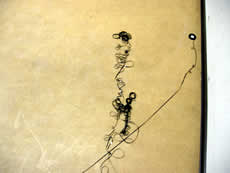 |
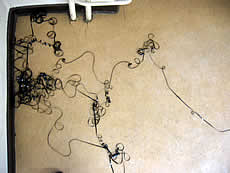
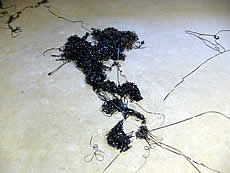
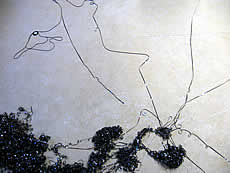
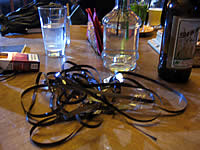
The first three afternoons, from february 7th to 9th, I set up a 'Found Tapes Atelier' in the Transitlounge (in the Josetti Höfe, Rungestraße), opposite the space where just-arrived-in-Berlin australian sound artist Rob Curgenven had wrought an intricate soundscape installation. The pictures above show you what the floor of my 'transit FT atelier' looked like. And in the middle of it all, there was the table where I sat drying and unraveling the tapes that I picked from the Berlin streets earlier on in the day.
Before and after the Transitlounge, also in Kunstprojektraum Takt I sat unraveling and rewinding found tapes. As much as I was able to manage, which - with the late hours, the evening concerts and preparations for my own performances at the das kleine (on thursday and on sunday evening) - was far less than I had hoped for. I had brought all still untreated tapes that I picked up before january 2007. Material for six new acquisitions (#68-#73). I only managed to get #68 done ...
And after the first sunny wednesday the weather turned bad.
Bad for spotting
tapes, that is.
First it started snowing.
Snow, of course, covers things up. Especially tapes.
Then in between snow showers much of what had fallen melted. And it rained
and all got wet. I usually spot the tapes 'out there', because strands flap in
the wind and I remark their peculiar way of reflecting the light. Now the
rain tends to 'flatten down' tape strands, the water weighs on them and
prevents them from 'flapping'. Because the 'wetness' moreover tends to make
almost anything reflect, it becomes much harder to distinguish
and spot tape clods.
So they have to find me ...
As for example that thursday morning, february 8th, when I was biking
on my own from Schöneweide to the Wülischstraßse. Not being
quite familiar yet with the neighborhood I got somewhat lost under s-bahn
bridges, not far from Ostkreuz. So I got off my bike, and stepped onto the
pavement. I stopped a woman that was approaching with her dog, and asked
whether she could tell me where the Wülischstraße was.
She did her best holding on to the dog, while waving with both her hands in a
direction away from Ostkreuz. Which I knew was wrong, so obviously
she didn't know. But I thanked her anyway. Then, before stepping onto my
bike again, I looked down at my feet ... There was a dirty wet, spungy,
brownish mass lying just next to my left shoe. No kidding. It really was
a clod of thrown away unthreaded cassette tape ...
 The
seven cast-away tape fragments that I did collect during my seven
day stay in Berlin include a first one found by Rinus some days before my
arrival, and part of a reel-to-reel tape purposedly destroyed by Wolfram
Der Spyra and Udo P. Leis following
their performance at the second 'Imaginary Homecoming' evening of das
kleine, on wednesday february 7th in Wendel. Together the seven add
up to the 78th acquisition and montage of the online
exhibition. As the exhibition is built-up in chronological order, it
may still take a while before you can find it online. Meanwhile though it
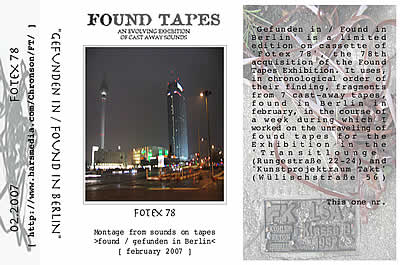
is available as a limited edition on C10 cassette. 'Found in Berlin' thus,
after 'Found in
Maastricht', is the second in what will be a series of 'Found in ...'
limited edition cassettes.
The
seven cast-away tape fragments that I did collect during my seven
day stay in Berlin include a first one found by Rinus some days before my
arrival, and part of a reel-to-reel tape purposedly destroyed by Wolfram
Der Spyra and Udo P. Leis following
their performance at the second 'Imaginary Homecoming' evening of das
kleine, on wednesday february 7th in Wendel. Together the seven add
up to the 78th acquisition and montage of the online
exhibition. As the exhibition is built-up in chronological order, it
may still take a while before you can find it online. Meanwhile though it
is available as a limited edition on C10 cassette. 'Found in Berlin' thus,
after 'Found in
Maastricht', is the second in what will be a series of 'Found in ...'
limited edition cassettes.
 |
The 'Found in Berlin' cassette is also part of my contribution to the 'Acoustic
Flux' exhibition, that started in Kunstprojektraum Takt on february 17th,
and which will continue until march 31st.  Other
contributors to 'Acoustic Flux' are Alexandre R. Decoupigny, Neil McIntee,
and the trio Miguel Álvarez-Fernández, Stefan Kersten and
Asia Piascik.
Other
contributors to 'Acoustic Flux' are Alexandre R. Decoupigny, Neil McIntee,
and the trio Miguel Álvarez-Fernández, Stefan Kersten and
Asia Piascik.
Towards the end of 'Found Tapes, Found Sounds, Found Recorders'
I prepared a 'found tapes installation' that I set up and left behind in
Takt, to become part of 'Acoustic Flux'. It is inspired by the last of the
two tape finds that I did in the very early morning of sunday january 21st,
while walking back home after having attended a concert at the Atelier Tampon,
with Jean Bordé, Dan Warburton, John Menoud and Benoit Moreau. On
a traffic island on the Saint-Mandé side of the porte de Vincennes
there lay a hub cap all wrapped in cassette tape ...
 That is why for the expo at Takt I decided to pick up and use some hub caps.
It's easy to pick up hub caps. Along highways and roads entering cities
there's lots of them. Somehow they came off the wheels they used to decorate.
I collected three (of at least four or five) that I had seen lying around
under the first of the two s-bahn viaducts on the Schlichtallee.
The picture on the left shows what I did with them. The upper left one is
branded Opel and the lower
left one: Renault. The
right one does not wear a visible 'brand' ...
It has a sort of 'seaweedy' feel to it, looking as it does like the rubbish
covered with weed structures that one finds along beaches. But that of course
is a pretty accurate analog, with hub caps wrapped in unthreaded cassette
tape being the sort of thing 'washing up' on the verges of our motorways
...
The 'Acoustic Flux' show continues until march 31st. I'll hop over again to Berlin for the finissage, and will be able to tell you more about the other contributes then.
- next: feelt -
notes __ ::
(*) Thus writes John Oltsik, senior analyst, in a
recent article
on ZDNet. I particularly enjoyed the 'random sleazebag' part, as you may
imagine... :-) [ ^ ]
(**) [added sept. 7, 2007] On the other hand, it would "only" take about 471.000 C60 cassettes
to make a cassette tape loop that runs around the earth. Now that would be *some* project, wouldn't it, to make a tape loop around
the earth ? ... Running at the speed of a normal audio cassette tape it would take about 27 years to make one complete
tour ... "There and back again" ... try to imagine a piece of music, a sound that would take 27 years to play ... that's mind-boggling ...
[ ^ ]
Read all about Found Tapes, Foundtaping and Audio Cassettes (K7s) on the SoundBlog:
(2023, september 21) - Holland[s] Spoor
(2022, january 11) - 'The Art of K7', vol. 1
(2021, september 11) - The Art of K7 :: Sudokaising [ii] Time Folds
(2020, march 21) - The Art of K7 :: Sudokaising [i]
(2019, november 17) - Foundtapers & Foundtaping in Porto
(2019, februay 08) - CCNL :: Cassette Culture in Linz, Austria
[ii] The aesthetics of erasure
(2019, januay 18) - CCNL :: Cassette Culture in Linz, Austria
[i] Oral history
(2015, november 22) - Situasonnisme: the City Sonic Festival
(2014, june 19) - Lecture de Cassette
(2013, october 25) - The Art of K7 (prelude) [sketch/book, 1]
(2013, march 23) - "Ma première cassette était vierge..." Mourning & celebrating 50 years of compact cassette
(2012, july 26) - UnOfficial Release
(2010, november 28) - Foundtaping, Maps & Shadows
at the Basel Shift Festival (i.)
(2009, november 15) - prof. dr. Cassette
(2009, november 08) - A found tapes meta-map
(2009, october 22) - Founded Tapapes
(2009, september 20) - Found Lost Sound
(2009, july 26) - "You, a bed, the sea ..." [ 1. Athens, sept. 28th 1994 ]
(2009, may 23) - It feels like summer in the city [KT2009, i]
(2009, february 19) - Time and the weather - "? Footage or Fetish" @ Käämer 12, Brussels (ii)
(2009, january 30) - A Tingel Tangle Tape Machine - "? Footage or Fetish" @ Käämer 12, Brussels (i)
(2009, january 15) - Kassettenkopf
(2008, december 08) - un-Tuned City (foundtaping in Neukölln)
(2008, september 14) - Psycho/Geo/Conflux in Brooklyn, NY __i.
(2008, august 31) - " Le chasseur " (foundtaping in brussels_ii)
(2008, june 18) - "Sing Laping, Sing !" (foundtaping in brussels_ i)
(2008, january 06) - Mo' Better Mo-Tapemosphere, 2. Restmuell
(2007, june 16) - Mo' Better Mo-Tapemosphere, 1. "chase away all my fear"
(2007, march 07) - Back to Berlin 2. Found Tapes
(2006, september 28) - jenny likes poets
(2006, september 06) - the sound of almost-no-more words
(2006, june 13) - fotex #49-51
(2006, june 04) - Sonofakunsttoer
(2006, april 17-25) - 'sudoku-solution' in 'de nor'
(2006, january 19) - ride, buggy, ride ... !
(2006, january 13) - axiologie for dummies
(2005, november 06) - found in maastricht
(2005, august 28) - tête-de-tettine / tête-de-cassette
(2005, august 23) - tape busters and coordinates
(2005, july 02) - Conquering America ...
(2005, june 03) - stationed soother
(2005, april 21) - Low-fi : the new Readymades
(2005, march 24) - d_Revolution #1 ...
(2005, february 07) - found tapes for spies
(2005, january 28) - "parfois l'amour tourne à l'obsession ..."
(2004, november 06) - à la tranquilité
(2004, july 20) - instructions in arabic
(2004, may 08) - phound stufphs
(2003, august 04) - new acquisitions #7, #8
(2003, may 04) - r2r
(2003, april 24) - splice and tape
(2003, april 15) - new acquisitions #5,#6
(2003, january 09) - finders keepers
(2002, november 24) - exhibit #4
(2002, november 08) - what fascinates me
(2002, november 07) - more on found tape montage
(2002, september 14) - detour
(2002, september 09) - 2 down, 3 to go
(2002, september 06) - magnetic migration
Read about Found Tapes in Gonzo (Circus) [Dutch]:
Gonzo #163, mei/juni 2021 - Lang Leve Lou Ottens
Gonzo #137, januari/februari 2017 - Het Kaf en het Koren
our podcasts:

